Wednesday, 26 July 2023

Generative AI Image Models: Pioneering the Path of Generative AI Development

Generative Artificial Intelligence (AI) development has witnessed significant advancements in recent years, revolutionizing various industries, including art, design, gaming, and even healthcare. Among the various facets of generative AI, the rise of generative AI image models has been particularly noteworthy. These models, driven by cutting-edge technologies like Generative Adversarial Networks (GANs) and Variational Autoencoders (VAEs), have demonstrated the ability to generate realistic and creative images autonomously. In this article, we will delve into the world of generative AI image models and explore their impact on the broader domain of AI development.

1. Understanding Generative AI Image Models

Generative AI image models are algorithms that can create images that appear strikingly similar to those seen in the real world. The core idea behind these models is to learn patterns and features from existing images and use that knowledge to generate new, unseen images. GANs, introduced by Ian Goodfellow and his colleagues in 2014, are widely employed in this context. GANs consist of two neural networks - a generator and a discriminator - that compete against each other, resulting in the generation of highly realistic images.

2. Key Components of Generative AI Image Models

a. Generator: The generator network in GANs learns from training data and generates new images that aim to deceive the discriminator. It starts by producing random noise and progressively improves its output to resemble real images.

b. Discriminator: The discriminator, also known as the critic, is another neural network that evaluates the images it receives, classifying them as either real or fake. Its primary goal is to distinguish between real images from the training dataset and the fake images produced by the generator.

3. Variational Autoencoders (VAEs)

In contrast to GANs, Variational Autoencoders (VAEs) are another popular class of generative AI models. VAEs are primarily used for unsupervised learning of complex data, including images. These models work by encoding input images into a compact representation (latent space), from which they can be decoded back into plausible images. The latent space allows for smooth interpolation between different image features, enabling the generation of novel images through sampling.

4. Applications of Generative AI Image Models

a. Art and Design: Generative AI image models have opened up new avenues for artists and designers to explore their creativity. They can use these models to generate unique visual elements, patterns, and textures, aiding in the creation of compelling artwork and innovative designs.

b. Gaming: The gaming industry has embraced generative AI image models for generating realistic characters, landscapes, and other in-game assets. This not only reduces the burden of manual asset creation but also enhances the gaming experience for players.

c. Data Augmentation: In various machine learning tasks, having a diverse and extensive dataset is crucial. Generative AI image models can be used to augment existing datasets with synthetically generated images, thereby improving the performance of AI models.

d. Medical Imaging: In healthcare, generative AI image models are employed to reconstruct medical images, enhance resolution, and even simulate various medical conditions, facilitating research and medical training.

5. Ethical Considerations

Generative AI image models have raised ethical concerns, especially in terms of generating realistic deepfakes, which can be misused for deceptive practices. Striking a balance between the creative potential and potential harm of these models remains a challenge.

Conclusion

Generative AI image models have become a driving force in the domain of generative AI development. Their ability to autonomously generate realistic and creative images has found applications across diverse industries. As technology progresses, it is essential to maintain ethical considerations and ensure the responsible use of these powerful generative AI tools. With continuous advancements in this field, the future holds exciting possibilities for the interplay between human creativity and artificial intelligence.

Foundation Models: The Backbone of AI Development Services

In the fast-paced world of artificial intelligence, the constant pursuit of more powerful and efficient models is a never-ending journey. Among the various breakthroughs in AI, foundation models have emerged as a crucial milestone, driving the progress of AI development services. These foundation models serve as the backbone on which numerous AI applications and advancements are built. In this article, we will explore what foundation models are and why they are essential in the realm of AI development services.

Understanding Foundation Models:

  1. Definition: Foundation models are large-scale neural network architectures designed to process vast amounts of data and learn patterns from it. They represent a significant leap forward in natural language processing, image recognition, and other AI tasks.
  2. GPT-3.5: One of the prominent examples of a foundation model is GPT-3.5, a state-of-the-art language model developed by OpenAI. It can comprehend human language, generate text, and perform various language-related tasks with astonishing accuracy.
  3. Pre-trained and Fine-tuned: Foundation models are pre-trained on massive datasets, which allows them to acquire a broad understanding of language and other data types. After pre-training, these models can be fine-tuned on specific tasks to excel in specialized applications.

The Need for a Foundation Model in AI Development Services:

  1. Efficiency: Foundation models eliminate the need to build AI models from scratch for every new project. They come pre-loaded with knowledge and can be fine-tuned for specific applications, saving valuable time and resources.
  2. Generalization: These models can generalize from the vast amount of data they have been exposed to during pre-training. This means they can comprehend and process a wide range of inputs, making them adaptable to various use cases.
  3. Complex Problem Solving: Foundation models have the capacity to tackle complex problem-solving tasks with advanced language understanding. They can answer questions, generate human-like text, and even perform language translation.
  4. Enhanced Performance: By utilizing foundation models, AI development services can significantly improve the performance of their applications. These models have a higher accuracy rate and can deliver more relevant results.
  5. Scalability: As foundation models are designed to handle large-scale data, they can be scaled up to accommodate growing demands, ensuring the AI services remain efficient even with increased users and data.
  6. Innovation: By leveraging the power of foundation models, AI developers can focus on pushing the boundaries of innovation rather than starting from scratch. This fosters faster experimentation and leads to groundbreaking AI applications.
  7. Cost-Effectiveness: Building and training an AI model from scratch can be costly and time-consuming. Foundation models, being pre-trained, provide a cost-effective solution to businesses and developers, enabling them to deliver AI-powered services at a fraction of the cost.

Conclusion:

In conclusion, foundation models are revolutionizing the field of AI development services. They offer a robust starting point for AI applications, allowing developers to fine-tune and customize them for specific tasks efficiently. With their ability to process vast amounts of data and generalize from it, foundation models open up new possibilities for innovation in AI. As the AI landscape continues to evolve, these models will remain an indispensable tool for businesses and developers seeking to harness the potential of artificial intelligence effectively.

AI in Private Equity: Transforming Investment Strategies

In the fast-paced and ever-evolving landscape of finance, the integration of cutting-edge technologies has become a game-changer. Among these innovations, Artificial Intelligence (AI) stands out as a transformative force in the private equity sector. AI development services have revolutionized the way private equity firms analyze data, identify investment opportunities, and manage their portfolios. In this article, we will explore the key points highlighting the impact of AI in private equity.


1. Data-Driven Decision Making:
AI development services have empowered private equity firms to make more informed decisions through data analysis. With access to vast amounts of structured and unstructured data, AI algorithms can process and extract valuable insights in real-time. This data-driven approach enables firms to identify potential investments, predict market trends, and assess risk with higher accuracy.

2. Enhanced Due Diligence:
AI-driven tools have streamlined the due diligence process for private equity firms. By automating time-consuming tasks such as document review, background checks, and financial analysis, AI reduces human errors and expedites the evaluation of potential targets. This efficiency gains a competitive edge by accelerating deal closures and enhancing deal quality.

3. Predictive Analytics:
Predictive analytics is a critical aspect of AI that has found a profound application in private equity. AI algorithms can analyze historical data, market trends, and macroeconomic indicators to forecast future performance and potential risks for investment targets. This foresight helps investors make strategic decisions and align their portfolios accordingly.

4. Deal Sourcing and Screening:
AI development services have significantly improved deal sourcing and screening processes. By scanning various sources such as news articles, social media, and company websites, AI-powered systems can identify potential investment opportunities. Moreover, AI-driven screening tools can quickly assess the suitability of targets based on predefined investment criteria.

5. Risk Management:
Managing risk is paramount in private equity. AI offers sophisticated risk management models that can evaluate portfolio performance, identify diversification opportunities, and assess market risks in real-time. This proactive risk management approach allows firms to mitigate potential losses and optimize their overall portfolio performance.

6. Automation of Repetitive Tasks:
AI has automated various routine tasks in private equity, enabling professionals to focus on more strategic activities. From generating reports and performance analysis to administrative tasks, AI-powered systems save time and resources, leading to greater operational efficiency.

7. Personalized Investor Insights:
AI-driven data analysis provides private equity firms with deeper insights into their investors' preferences and behaviors. This knowledge helps create personalized investment solutions, tailored to meet the unique requirements of individual investors. Such customized offerings foster stronger relationships and build investor confidence.

8. Exit Strategy Optimization:
For private equity firms, a successful exit strategy is crucial for maximizing returns. AI algorithms can assess market conditions, industry trends, and company performance to determine the ideal timing and approach for exit strategies. This data-driven exit planning enhances the chances of achieving optimal returns.

9. Portfolio Optimization:
AI can optimize portfolio construction by considering various factors like risk tolerance, liquidity, and investment objectives. By continuously monitoring and rebalancing portfolios, AI ensures that investments align with changing market conditions and investor preferences.

10. Regulatory Compliance:
AI technology aids private equity firms in complying with complex regulatory requirements. Through automated monitoring and reporting, AI ensures that all investment activities are in line with legal frameworks, reducing the risk of compliance breaches.

Conclusion:
AI development services have undeniably transformed the private equity landscape. With data-driven decision making, predictive analytics, and enhanced risk management, AI empowers firms to identify lucrative investment opportunities and optimize their portfolios. By automating tasks, streamlining due diligence, and providing personalized insights, AI adds value at every stage of the investment process. As AI continues to advance, private equity firms that embrace this technology will undoubtedly gain a competitive edge, solidifying their position as leaders in the dynamic world of finance.

Monday, 24 July 2023

Exploring the Advantages of AI-Powered Chatbots

In recent years, the world of customer service and business interactions has seen a remarkable transformation with the rise of artificial intelligence (AI) and chatbot technology. A chatbot is an AI-powered virtual assistant designed to interact with users in a conversational manner, simulating human conversation through text or speech. AI chatbot development services have gained immense popularity among businesses due to their ability to enhance customer engagement, streamline operations, and provide personalized experiences. In this article, we will delve into what a chatbot is and explore the key advantages of using AI-powered chatbots.

What is a Chatbot?

A chatbot is an AI-driven computer program that communicates with users through natural language processing (NLP) capabilities. These intelligent bots are capable of understanding user queries and providing relevant responses, offering a seamless and human-like conversation experience. They can be integrated into various platforms such as websites, messaging apps, and social media, enabling businesses to automate customer interactions and efficiently handle a wide range of tasks.

Advantages of AI-Powered Chatbot Development Services

  1. Enhanced Customer Support: One of the most significant advantages of AI chatbot development services is the provision of 24/7 customer support. Unlike human agents, chatbots never tire, ensuring uninterrupted assistance to customers at any time of day. With rapid response times and accurate answers to frequently asked questions, chatbots improve customer satisfaction and retention.
  2. Cost Savings: Implementing chatbots can lead to substantial cost savings for businesses. By automating repetitive tasks and handling multiple customer inquiries simultaneously, chatbots reduce the need for a large customer support team. This optimization of resources allows businesses to allocate their budget more efficiently and invest in other critical areas.
  3. Personalized Customer Experiences: AI-powered chatbots have the ability to analyze user data and preferences, enabling them to deliver personalized experiences. By understanding individual customer needs, chatbots can suggest tailored products or services, ultimately leading to higher conversion rates and increased customer loyalty.
  4. Improved Lead Generation and Sales: Chatbots can act as effective sales representatives, guiding potential customers through the buyer's journey. By asking relevant questions and offering personalized recommendations, chatbots assist in identifying qualified leads and driving conversions. Their proactive approach fosters customer engagement and assists in closing deals more effectively.
  5. Efficient Task Automation: Beyond customer support, chatbots excel in automating various business tasks. They can schedule appointments, process orders, track shipments, and even handle internal HR queries. This automation streamlines operations, reducing manual errors and allowing human employees to focus on more complex and creative tasks.
  6. Scalability and Flexibility: As businesses grow, the demand for customer support and engagement increases exponentially. AI chatbot development services offer scalability to handle high volumes of queries without compromising on quality. Moreover, chatbots can be easily adapted to different industries and use cases, making them a versatile tool for diverse businesses.

Conclusion

AI chatbot development services have revolutionized the way businesses interact with their customers. By providing round-the-clock support, streamlining operations, and offering personalized experiences, chatbots enhance customer satisfaction and drive business growth. The cost savings achieved through automation and the ability to handle a large number of inquiries make chatbots a valuable asset for any organization. As technology continues to advance, we can expect chatbots to become even more sophisticated and integral to modern businesses across various sectors. Embracing this AI-driven technology is no longer a choice but a necessity for businesses looking to stay competitive in today's fast-paced world.

AI as a Service: Empowering Businesses with Smart Solutions

 In the rapidly evolving landscape of technology, artificial intelligence (AI) has emerged as a transformative force, revolutionizing industries across the globe. As businesses strive to stay competitive and meet ever-changing consumer demands, the adoption of AI technologies has become crucial. However, integrating AI into existing systems can be complex and resource-intensive. Enter AI as a Service (AIaaS), a game-changing model that democratizes AI access and empowers organizations of all sizes with smart solutions. In this article, we will explore the concept of AIaaS, its benefits, and its impact on various industries.


What is AI as a Service?

AI as a Service refers to the delivery of AI capabilities through cloud-based platforms. Instead of companies investing heavily in building and maintaining AI infrastructure, AIaaS providers offer access to powerful AI tools and algorithms via the Internet. This on-demand model allows businesses to leverage AI without significant upfront costs, making it more accessible to startups, small and medium-sized enterprises (SMEs), and even larger corporations.


Benefits of AI as a Service

1. Cost-Effective: Traditional AI implementation involves substantial expenses in terms of hardware, software, and skilled personnel. AIaaS eliminates these upfront costs, enabling businesses to pay only for the resources they consume, making it a more cost-effective option.

2. Scalability: As businesses grow, their AI requirements may also change. AIaaS platforms offer scalability, allowing companies to easily adjust their AI resources to accommodate fluctuations in demand.

3. Faster Deployment: Implementing AI in-house can be time-consuming, requiring extensive development and testing. With AIaaS, businesses can access pre-built AI models and services, significantly reducing deployment time.

4. Accessibility: AIaaS breaks down barriers to entry for organizations that lack the expertise or infrastructure to develop AI solutions internally. It empowers companies in various sectors, regardless of their size, to benefit from AI-driven insights and automation.

5. Updates and Maintenance: AIaaS providers handle updates, maintenance, and security, freeing businesses from the burden of managing complex AI systems. This ensures that companies always have access to the latest advancements in AI technology.


Applications of AI as a Service

1. Natural Language Processing (NLP): NLP services offered through AIaaS platforms enable businesses to analyze text data, perform sentiment analysis, and build chatbots for enhanced customer support.

2. Image and Video Analysis: AIaaS solutions provide image and video recognition capabilities, empowering businesses with object detection, facial recognition, and content moderation.

3. Predictive Analytics: Companies can leverage AIaaS for predictive modeling, forecasting, and data-driven decision-making, gaining a competitive edge in their respective industries.

4. Personalization: AI-powered recommendation engines, available through AIaaS, enhance customer experiences by delivering personalized products or content suggestions.

5. Robotic Process Automation (RPA): AIaaS can be integrated with RPA to automate repetitive tasks, streamlining workflows and increasing efficiency.


Impact on Industries

1. Healthcare: AIaaS is revolutionizing the healthcare sector by enabling accurate diagnostics, drug discovery, and personalized treatment plans, ultimately improving patient outcomes.

2. Finance: In the financial industry, AIaaS is pivotal in fraud detection, risk assessment, and algorithmic trading, optimizing processes and minimizing risks.

3. Retail: AI-powered recommendation engines and demand forecasting tools have transformed the retail landscape, providing customers with personalized shopping experiences and helping businesses optimize their inventory management.

4. Manufacturing: AIaaS is driving the adoption of predictive maintenance and process optimization in manufacturing, reducing downtime and improving productivity.


Conclusion

AI as a Service has emerged as a game-changer, democratizing AI access and empowering businesses with cutting-edge solutions. By offering cost-effective and scalable AI capabilities, AIaaS is driving innovation across various industries, from healthcare to finance and retail. As technology continues to advance, the impact of AIaaS is expected to grow, revolutionizing the way businesses operate and delivering enhanced value to customers worldwide. Embracing AIaaS will be a key differentiator for organizations seeking to thrive in the ever-evolving digital age.

Generative AI Use Cases in Healthcare

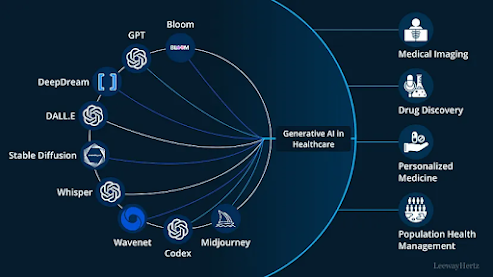
The field of healthcare has experienced a significant transformation with the advent of advanced technologies like Generative Artificial Intelligence (AI). Generative AI utilizes machine learning algorithms to create new data, images, and text based on patterns and existing information. In healthcare, this cutting-edge technology has proven to be a game-changer, revolutionizing various aspects of medical practice and research. In this article, we will explore ten compelling use cases of Generative AI in healthcare, highlighting its potential to enhance patient care, diagnosis, treatment, and medical advancements.

1. Medical Imaging Enhancement

Generative AI algorithms are employed to enhance the quality of medical images, making them clearer and more accurate. This technology can reduce image noise, enhance contrast, and reconstruct missing or degraded portions, aiding radiologists and other healthcare professionals in making more precise diagnoses.


2. Synthetic Data Generation

Training machine learning models often requires large datasets, but acquiring such datasets with sensitive medical information can be challenging due to privacy concerns. Generative AI allows the generation of synthetic medical data that retains the statistical characteristics of real data, enabling researchers to develop and validate models without compromising patient privacy.


3. Drug Discovery

The drug discovery process is time-consuming and costly. Generative AI can significantly speed up this process by predicting molecular structures that could be potential candidates for new drugs. It simulates chemical reactions and interactions, suggesting novel compounds for further testing and development.


4. Personalized Treatment Plans

Generative AI can analyze a patient's medical history, genetic makeup, and other relevant factors to generate personalized treatment plans. These plans take into account individual variations, improving the efficacy of treatment and reducing adverse effects.


5. Medical Text Generation

Generating accurate and comprehensive medical reports can be a time-consuming task for healthcare providers. Generative AI can assist in automatically generating medical notes, summaries, and patient reports, enabling doctors to spend more time on direct patient care.


6. Disease Progression Prediction

By analyzing patient data over time, Generative AI can predict disease progression and potential complications. This early warning system allows healthcare professionals to intervene proactively, leading to better patient outcomes and reduced hospitalization rates.


7. Surgical Simulation and Training

Generative AI is used to create realistic surgical simulations, providing medical students and surgeons with a safe environment to practice complex procedures. This technology helps improve surgical skills and fosters innovative techniques, ultimately enhancing patient safety during real operations.


8. Mental Health Diagnosis and Treatment

Generative AI can be employed to analyze patient data, including speech patterns and behavior, to assist in diagnosing mental health conditions. Moreover, it can generate personalized therapy interventions and support tools to aid in the treatment of various mental health disorders.


9. Prosthetics and Assistive Devices

Generative AI plays a crucial role in designing and customizing prosthetics and assistive devices to better suit individual patients. By analyzing biomechanical data and patient preferences, these devices can be optimized for comfort, functionality, and aesthetics.


10. Radiology Report Generation

Interpreting complex radiological images and generating comprehensive reports is demanding for radiologists. Generative AI can automatically analyze medical images and produce structured and standardized radiology reports, facilitating more efficient communication among healthcare teams.


Conclusion

Generative AI has opened up a world of possibilities in healthcare, revolutionizing medical practice, research, and patient care. From improving medical imaging and drug discovery to enhancing surgical training and mental health treatment, the impact of this technology is profound and promising. As Generative AI continues to evolve, it will undoubtedly play an increasingly critical role in shaping the future of healthcare, leading to better diagnoses, more effective treatments, and improved patient outcomes. Nonetheless, it is essential to ensure ethical considerations, data privacy, and regulatory compliance while harnessing the full potential of Generative AI in healthcare domain.

Monday, 17 July 2023

Exploring Different Types of Foundation Models

Artificial Intelligence (AI) has witnessed tremendous growth in recent years, with advancements in machine learning and deep learning algorithms. Foundation models serve as the building blocks for various AI applications, providing the necessary knowledge and framework to solve complex problems. In this article, we will delve into the different types of foundation models in AI development services and explore how they work.


1. Feedforward Neural Networks:

- Feedforward neural networks are the most basic type of foundation model in AI.

- They consist of interconnected layers of artificial neurons, with information flowing in one direction, from input to output.

- These models are primarily used for pattern recognition, classification, and regression tasks.

- The learning process involves adjusting the weights and biases of the neurons to minimize the difference between predicted and actual outputs.


2. Convolutional Neural Networks (CNNs):

- CNNs are widely employed in computer vision tasks, such as image and video recognition.

- They consist of convolutional layers that extract features from input data, followed by fully connected layers for classification.

- CNNs leverage filters to detect patterns and spatial relationships within images.

- The training process involves adjusting the filter weights to minimize the difference between predicted and expected output.


3. Recurrent Neural Networks (RNNs):

- RNNs are designed to handle sequential data, making them suitable for tasks involving time series analysis, natural language processing, and speech recognition.

- These models possess a feedback mechanism that enables information to flow in cycles.

- RNNs retain the memory of previous inputs, allowing them to capture dependencies and contextual information.

- The training process involves backpropagation through time to adjust the weights and biases, optimizing the model for sequential data.


4. Generative Adversarial Networks (GANs):

- GANs are unique foundation models that consist of two neural networks: a generator and a discriminator.

- The generator network generates synthetic data samples, while the discriminator network learns to distinguish between real and fake samples.

- GANs are widely used in tasks such as image synthesis, style transfer, and data augmentation.

- The training process involves a competitive game between the generator and discriminator, with both networks improving their performance iteratively.


5. Transformer Models:

- Transformer models have revolutionized the field of natural language processing (NLP).

- They leverage self-attention mechanisms to capture relationships between different words in a sentence or document.

- Transformer models, such as the famous BERT (Bidirectional Encoder Representations from Transformers), have achieved state-of-the-art results in tasks like text classification, named entity recognition, and language translation.

- The training process involves unsupervised pre-training followed by fine-tuning on specific tasks.


Conclusion:

Foundation models serve as the backbone of AI development services, enabling the creation of sophisticated and intelligent systems. From feedforward neural networks to transformer models, each type offers unique capabilities to tackle diverse challenges. As AI continues to advance, it is crucial to understand the strengths and limitations of different foundation models to harness their full potential in solving complex problems. By leveraging these models effectively, AI development services can unlock new possibilities and drive innovation across various industries.

Top 10 AI Implementation Companies in USA

In 2026, Artificial Intelligence is no longer just a strategic differentiator—it has transformed into a fundamental operational requirement....