Showing posts with label generative ai use cases. Show all posts

Monday, 24 July 2023

Generative AI Use Cases in Healthcare

The field of healthcare has experienced a significant transformation with the advent of advanced technologies like Generative Artificial Intelligence (AI). Generative AI utilizes machine learning algorithms to create new data, images, and text based on patterns and existing information. In healthcare, this cutting-edge technology has proven to be a game-changer, revolutionizing various aspects of medical practice and research. In this article, we will explore ten compelling use cases of Generative AI in healthcare, highlighting its potential to enhance patient care, diagnosis, treatment, and medical advancements.
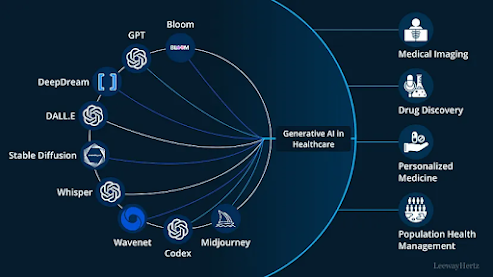
1. Medical Imaging Enhancement

Generative AI algorithms are employed to enhance the quality of medical images, making them clearer and more accurate. This technology can reduce image noise, enhance contrast, and reconstruct missing or degraded portions, aiding radiologists and other healthcare professionals in making more precise diagnoses.


2. Synthetic Data Generation

Training machine learning models often requires large datasets, but acquiring such datasets with sensitive medical information can be challenging due to privacy concerns. Generative AI allows the generation of synthetic medical data that retains the statistical characteristics of real data, enabling researchers to develop and validate models without compromising patient privacy.


3. Drug Discovery

The drug discovery process is time-consuming and costly. Generative AI can significantly speed up this process by predicting molecular structures that could be potential candidates for new drugs. It simulates chemical reactions and interactions, suggesting novel compounds for further testing and development.


4. Personalized Treatment Plans

Generative AI can analyze a patient's medical history, genetic makeup, and other relevant factors to generate personalized treatment plans. These plans take into account individual variations, improving the efficacy of treatment and reducing adverse effects.


5. Medical Text Generation

Generating accurate and comprehensive medical reports can be a time-consuming task for healthcare providers. Generative AI can assist in automatically generating medical notes, summaries, and patient reports, enabling doctors to spend more time on direct patient care.


6. Disease Progression Prediction

By analyzing patient data over time, Generative AI can predict disease progression and potential complications. This early warning system allows healthcare professionals to intervene proactively, leading to better patient outcomes and reduced hospitalization rates.


7. Surgical Simulation and Training

Generative AI is used to create realistic surgical simulations, providing medical students and surgeons with a safe environment to practice complex procedures. This technology helps improve surgical skills and fosters innovative techniques, ultimately enhancing patient safety during real operations.


8. Mental Health Diagnosis and Treatment

Generative AI can be employed to analyze patient data, including speech patterns and behavior, to assist in diagnosing mental health conditions. Moreover, it can generate personalized therapy interventions and support tools to aid in the treatment of various mental health disorders.


9. Prosthetics and Assistive Devices

Generative AI plays a crucial role in designing and customizing prosthetics and assistive devices to better suit individual patients. By analyzing biomechanical data and patient preferences, these devices can be optimized for comfort, functionality, and aesthetics.


10. Radiology Report Generation

Interpreting complex radiological images and generating comprehensive reports is demanding for radiologists. Generative AI can automatically analyze medical images and produce structured and standardized radiology reports, facilitating more efficient communication among healthcare teams.


Conclusion

Generative AI has opened up a world of possibilities in healthcare, revolutionizing medical practice, research, and patient care. From improving medical imaging and drug discovery to enhancing surgical training and mental health treatment, the impact of this technology is profound and promising. As Generative AI continues to evolve, it will undoubtedly play an increasingly critical role in shaping the future of healthcare, leading to better diagnoses, more effective treatments, and improved patient outcomes. Nonetheless, it is essential to ensure ethical considerations, data privacy, and regulatory compliance while harnessing the full potential of Generative AI in healthcare domain.

Friday, 23 June 2023

Exploring the Power and Potential of Generative AI Use Cases

The world of artificial intelligence continues to evolve, and one of the most fascinating areas of development is generative AI. Generative AI refers to a branch of artificial intelligence that focuses on generating or creating new content, whether it's images, videos, music, or even text, using machine learning algorithms. With its ability to mimic and generate realistic content, generative AI has found numerous applications across various industries. In this article, we will delve into the exciting generative AI use cases and explore how it is transforming different fields.


1. Creative Content Generation

Generative AI has revolutionized creative content generation by enabling the creation of visually stunning and unique artwork. Artists and designers can leverage generative AI algorithms to generate new patterns, designs, and compositions, pushing the boundaries of their creativity. By using generative adversarial networks (GANs), artists can train AI models to generate realistic images and videos that possess artistic qualities. This has opened up new avenues for artistic expression and has even led to AI-generated artwork being sold in prestigious galleries.


2. Virtual Reality and Gaming

Generative AI has made significant strides in the virtual reality (VR) and gaming industries. With the help of generative algorithms, developers can create immersive and realistic virtual environments. These algorithms can generate dynamic landscapes, lifelike characters, and compelling narratives, enhancing the overall gaming experience. Additionally, generative AI can generate procedural content, such as maps and levels, ensuring that games offer endless possibilities and unique gameplay for players.


3. Personalized User Experiences

Generative AI has the potential to transform the way we experience online platforms and services. By analyzing user data and preferences, AI algorithms can generate personalized recommendations, whether it's movies, music, or products. This enables businesses to offer tailored experiences to their users, enhancing customer satisfaction and engagement. Moreover, generative AI can create virtual assistants and chatbots that provide more natural and interactive interactions, making customer support and communication more efficient.


4. Healthcare and Medicine

In the field of healthcare, generative AI holds tremendous promise. It can aid in medical image analysis, helping doctors detect and diagnose diseases more accurately. Generative models can generate synthetic medical images, enabling researchers to study rare conditions and test potential treatments. Moreover, generative AI can be used to develop personalized treatment plans based on a patient's medical history and genetic data, leading to more precise and effective healthcare interventions.


5. Fashion and Design

Generative AI has found exciting applications in the fashion and design industries. Fashion designers can utilize AI algorithms to generate new and innovative clothing designs, patterns, and color combinations. This allows designers to explore uncharted territories and create avant-garde fashion pieces. Additionally, generative AI can assist in virtual try-on experiences, enabling customers to visualize how a particular garment would look on them before making a purchase.


6. Content Generation and Writing

Generative AI has made remarkable progress in natural language processing, enabling the generation of coherent and contextually relevant text. This has implications for various industries, including journalism, content creation, and marketing. AI algorithms can generate news articles, blog posts, and product descriptions, saving time and effort for content creators. While the technology is not yet perfect, it shows great potential in automating repetitive writing tasks, allowing writers to focus on more creative and strategic aspects of their work.


Conclusion

Generative AI has emerged as a powerful tool with diverse applications across multiple industries. From creative content generation to personalized user experiences, and healthcare advancements to fashion and design innovations, the potential of generative AI is vast and continually expanding. While ethical considerations and responsible use remain important, it is undeniable that generative AI is transforming the way we create, experience, and interact with various forms of content. As the technology continues to evolve, we can expect even more groundbreaking use cases and exciting possibilities in the future.

Friday, 14 April 2023

Exploring Generative AI Use Cases

 Generative AI is a type of artificial intelligence that enables machines to create something new, whether it's a piece of music, a painting, or a story. This technology has a wide range of applications, and it's rapidly becoming a popular tool in many industries. In this article, we'll discuss some of the most popular generative ai use cases for generative AI services.

  1. Content creation

Generative AI can be used to create all kinds of content, from articles and blogs to videos and images. For example, companies can use generative AI to create product descriptions, social media posts, and other forms of content automatically, saving time and money. This technology is especially useful for companies that need to produce a large amount of content on a regular basis.

  1. Personalization

Generative AI can also be used to personalize content for individual users. By analyzing a user's preferences, interests, and behavior, generative AI can create personalized recommendations for products, services, and content. For example, a streaming service could use generative AI to create personalized playlists for each user based on their listening history.

  1. Gaming

Generative AI is also being used in the gaming industry to create new and innovative games. This technology can be used to create game environments, characters, and even game mechanics. In some cases, generative AI can also be used to create levels that are randomly generated, making the game more challenging and exciting.

  1. Music

Generative AI can also be used to create music. By analyzing existing music and creating new combinations of notes, generative AI can create original pieces of music that are unique and creative. This technology is especially useful for musicians who are looking for inspiration or want to explore new musical styles.

  1. Design

Generative AI can also be used to create designs for products, logos, and other branding materials. By analyzing existing designs and creating new combinations of colors, shapes, and patterns, generative AI can create original designs that are both aesthetically pleasing and functional.

  1. Healthcare

Generative AI is also being used in the healthcare industry to improve patient care. For example, generative AI can be used to analyze medical data and create personalized treatment plans for patients. This technology can also be used to create 3D models of organs and other structures in the body, making it easier for doctors to diagnose and treat medical conditions.

  1. Language translation

Generative AI can also be used to translate languages automatically. By analyzing large amounts of data, generative AI can create accurate translations of text and speech. This technology is especially useful for companies that need to translate content for a global audience.

  1. Robotics

Generative AI is also being used in the robotics industry to create robots that can adapt to their environment. For example, generative AI can be used to create robots that can learn how to navigate a new environment or perform a new task. This technology is especially useful for industries such as manufacturing and logistics.

  1. Education

Generative AI can also be used in education to create personalized learning experiences for students. By analyzing a student's performance and behavior, generative AI can create personalized learning plans that are tailored to their individual needs. This technology can also be used to create educational content, such as textbooks and tutorials, that are tailored to a student's learning style.

  1. Marketing

Generative AI can also be used in marketing to create personalized marketing campaigns. By analyzing a customer's behavior and preferences, generative AI can create marketing messages and campaigns that are tailored to their interests. This technology can also be used to create targeted advertising that is more effective and efficient.

In conclusion, generative AI has a wide range of use cases and is rapidly becoming a popular tool in many industries. From content creation and personalization to healthcare and education, generative AI services are transforming the way we approach various tasks and processes. As technology continues to advance, it's likely that we'll see even more use cases for generative AI in the future.

Top 10 AI Implementation Companies in USA

In 2026, Artificial Intelligence is no longer just a strategic differentiator—it has transformed into a fundamental operational requirement....